From validation-ready to validated: a smarter approach to eQMS validation


Why does eQMS validation take so much time?
For life sciences organizations, implementing an electronic Quality Management System (eQMS) involves more than deploying software. Quality teams must also demonstrate that the system meets its intended use, supports business processes, and operates in accordance with applicable regulatory requirements.
This is where implementation projects can become lengthy and costly. Organizations often start validation from scratch, manually prepare documentation, execute extensive testing, and struggle to coordinate requirements, evidence, and responsibilities.
But validation is much more than testing. As Valarie King Baley, CEO of OnShore Technology Group, explained during our recent webinar, testing is only one part of a broader, risk-based process designed to provide documented evidence that an eQMS meets its intended use. This approach is also reflected in the FDA's Computer Software Assurance (CSA) principles, which encourage organizations to apply critical thinking, assess risk, and focus assurance activities where they matter most.
The objective is not simply to perform fewer tests. It is to make validation more effective by directing effort towards functionality that has the greatest impact on product quality, patient safety, and business operations.
Start with a validated baseline, then focus on what is unique to your organization
One way to accelerate eQMS implementation is to avoid starting validation with a blank sheet of paper. A Microsoft 365-native eQMS such as BPAMedical365 provides preconfigured quality processes, including CAPA, nonconformance, change control, customer complaints, and supplier management. These processes provide a structured starting point that can be configured to reflect each organization's specific requirements. Through its partnership with OnShore Technology Group, BPA combines this platform with a dedicated validation approach and supporting documentation.
The BPAMedical365 Validation Toolkit provides a foundation for the validation lifecycle, accelerating validation and streamlining future re-validation following major software releases or configuration updates. The toolkit includes a complete, audit-ready documentation suite that spans every stage of the validation lifecycle, from planning through testing and summary reporting:
- Pre-populated validation documents templates
- Predefined requirements and traceability specifications
- Ready-to-execute test scripts representing the system’s core, out-of-the-box functionalities
- Validation evidence supporting execution records and summary documentation.
However, an important distinction remains: validation-ready does not mean automatically validated for every organization.
The provided documentation and tested out-of-the-box functionality establish a validation baseline. Each organization must then supplement this foundation with its own requirements, specific configurations, and supporting evidence to demonstrate that the system meets its intended use.
A practical implementation and validation roadmap therefore includes the following key steps:
- Plan and align: define business objectives, scope, and a risk-based validation strategy.
- Configure: identify and implement the requirements that go beyond standard functionality.
- Validate: assess risks and perform testing appropriate to the criticality of each requirement.
- Train and prepare: ensure users understand the processes and their responsibilities.
- Migrate and go live: verify legacy data integrity and prepare the system for operational use.
Smarter validation means faster deployment and sustained compliance
A risk-based approach does not mean compromising validation quality. It means applying the appropriate level of assurance to each requirement. Following FDA CSA principles and GAMP 5 guidance, functionality can be categorized according to risk:
- High-risk requirements: typically require more rigorous, documented and scripted testing.
- Moderate-risk requirements: may combine scripted and unscripted testing, depending on the associated risks.
- Low-risk requirements: may be supported through unscripted testing and documented summaries where appropriate.
By combining a preconfigured eQMS baseline, structured validation documentation, digital validation tools, and risk-based testing, organizations can avoid duplicating work and focus their resources where they bring the greatest value. For Quality and Regulatory teams, this translates into concrete benefits:
- Faster time to value: reduce implementation complexity by building on established quality workflows and a documented baseline.
- Less validation effort: avoid starting from scratch and focus testing on critical requirements and organization-specific configurations.
- Greater visibility and control: centralize requirements, test evidence, and validation records.
- Stronger compliance foundations: establish documented evidence and clear responsibilities to support a validated system throughout its operational lifecycle.
Ultimately, the goal is not simply to implement an eQMS and complete its initial validation. It is to establish a reliable quality management foundation that supports your processes and remains under control as your organization evolves.
Want to see how this works in practice?
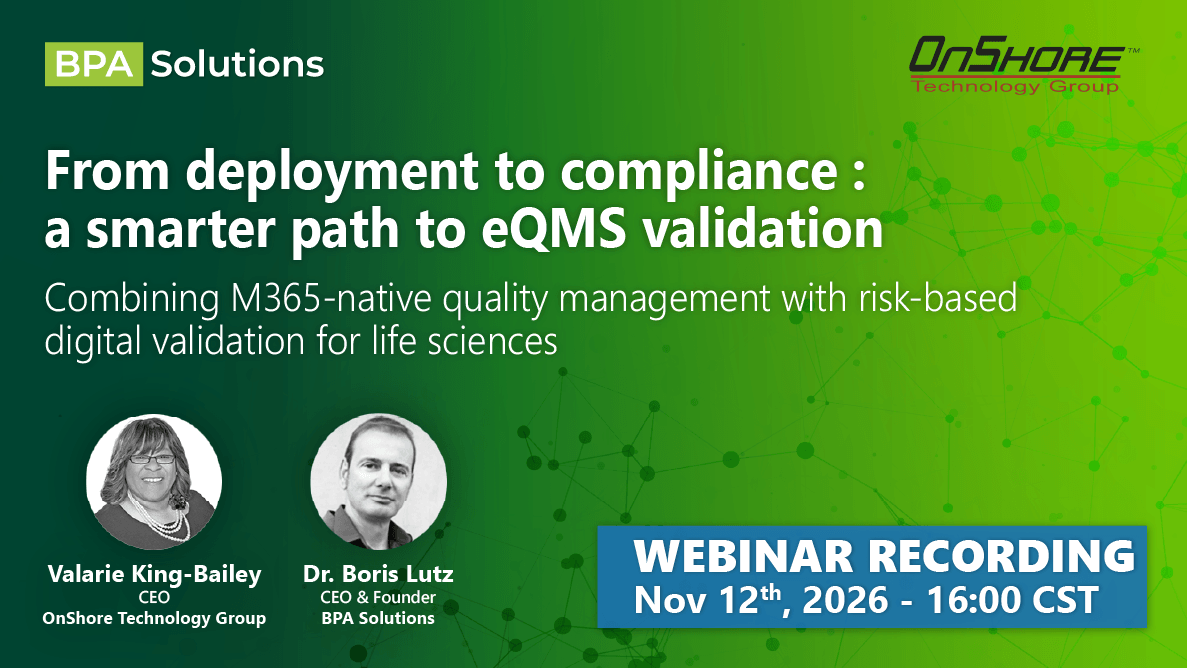
Watch the recording of our webinar "From deployment to compliance: a smarter path to eQMS validation", to see BPAMedical365 in action and hear Valarie King Baley explain the risk-based validation approach. You can also download our BPAMedical365 Validation Toolkit overview to discover the documentation included in the package and understand how it can help accelerate your validation journey.